

TAC DINE CP-10
Penetrating Adhesive for Cracks
A low-viscosity, solvent-free, two-component material for penetrating hairline cracks generally up to 0.5 mm and re-bonding the repair area to existing concrete. It can be applied without special pressure-injection equipment.
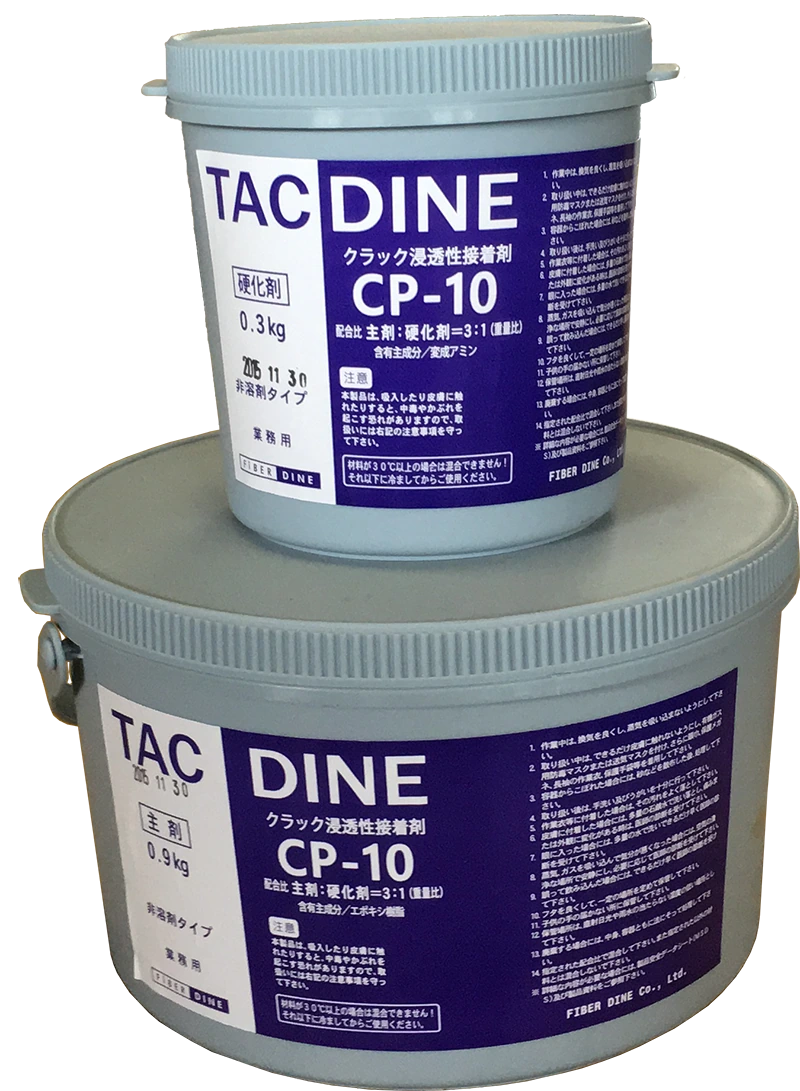
Basic specifications
- Product category
- Penetrating adhesive for cracks
- Mixing ratio
- Base: hardener = 3:1 by weight
- Package
- 1.5 kg base + 0.5 kg hardener (2.0 kg total)
- Target
- Hairline cracks up to 0.5 mm
- Features
- Low viscosity / solvent-free / re-bonding to existing concrete
Applications
Penetration into hairline cracks
The low-viscosity material penetrates narrow gaps and assists bonding inside the crack.
Re-bonding to existing concrete
Material penetrating around the crack re-bonds the repair area to existing concrete.
Application without pressure equipment
For hairline cracks up to 0.5 mm without pressure-injection equipment.
Why consider solvent-free CP-10
PS-10(G) is temporarily out of production. Where the application is suitable, CP-10 may be considered as a low-viscosity, solvent-free option. Compared with solvent-based materials, it can reduce concerns associated with solvent-derived odor and volatile components; ventilation, PPE and other SDS precautions still apply. CP-10 does not replace every PS-10(G) application.
Performance data
The CP-10 product specification and the technical paper on concrete-crack repair use different JIS references for the tensile test. For engineering use, confirm the test conditions stated in each document.
Selection and application
Selection
For penetrating hairline cracks up to 0.5 mm with a low-viscosity resin without pressure equipment.
Application
Confirm crack width and substrate condition, then use the material’s low viscosity to penetrate the crack and re-bond it to the existing concrete.
Documents
Documents are provided as original Japanese-language PDFs. Each card includes a concise English summary for orientation.
Japanese specification covering CP-10 for low-viscosity, solvent-free penetration and adhesion of hairline cracks and application without special pressure equipment. Published source materials use different JIS references for the tensile test, so engineering use should confirm the original test conditions.
Japanese application guide for crack preparation, sealing, 3:1 mixing by weight, low-temperature handling, gravity injection and finishing after cure. Its 1 mm crack-width figure is a quantity-calculation example and does not state a CP-10 application-width limit.
Japanese safety data covering composition and hazards, first aid, fire and spill response, handling and storage, protective equipment, disposal and transport for the base and hardener.